How Do Local Roofing Contractors Back Their Work?
Two different warranties, and most homeowners think they're one thing. One covers the shingles. The other covers whether they were installed correctly — and that second one is worth more, because nearly every roof failure is an installation failure rather than a product failure.
By Eric Haugh, Owner · Last updated September 14, 2026
What's the Difference Between the Two Warranties?
This is the distinction to get straight before comparing quotes.
The manufacturer warranty comes from whoever made the shingles and covers material defects — granule loss outside spec, delamination, premature failure of the product itself. It's typically prorated after an initial period, and it does nothing at all if the roof leaks because the flashing was wrong.
The workmanship warranty comes from the contractor and covers installation. Wrong nail placement, flashing detailed incorrectly, inadequate ventilation, penetrations not sealed properly. This is the one that matters most, because in practice the overwhelming majority of roof problems trace to how it went on rather than what went on.
Every project we do is backed by a workmanship warranty. When comparing local roofing contractors Graham WA homeowners are considering, ask for the term in years and whether it's transferable to a buyer — a transferable warranty is worth real money at resale, and plenty aren't.
One thing worth knowing: a manufacturer warranty can be voided by installation error, which is the trap. If the roof was installed outside the manufacturer's specification, the product cover you thought you had may not respond. So the two warranties aren't independent — the workmanship determines whether the material one survives.
How Do Manufacturer Certification Programs Work?
Worth understanding, because the marketing around them is heavier than the substance sometimes warrants.
Major manufacturers — GAF and Owens Corning among them — run contractor certification tiers. A contractor meets the manufacturer's criteria, and in exchange gains access to enhanced system warranties that uncertified contractors can't offer. Those enhanced warranties typically cover the roofing system rather than the shingles alone, sometimes including workmanship for a defined period, and are usually longer and less aggressively prorated than the standard product warranty.
Two honest caveats. Certification is a manufacturer's commercial programme rather than a state credential, so it doesn't replace L&I registration or tell you anything about a company's financial standing. And an enhanced warranty generally requires the full system — the manufacturer's underlayment, starter, ridge and ventilation, not just their shingles — which affects the quote.
What you should do regardless: if a contractor offers an enhanced manufacturer warranty, ask which program, at what tier, and what the full system requirement means for your specification.
What Can a Contractor Legally Do on an Insurance Claim?
Less than some of them advertise, and knowing the line protects you.
Under RCW 48.17.410, an adjuster's license authorizes investigating and negotiating settlement relative to insurance claims — on behalf of insureds where the person is licensed as a public adjuster. Adjusters are licensed by the Office of the Insurance Commissioner.
So negotiating your settlement is adjuster work, not roofing work. A contractor offering to argue scope with your insurer, or telling you they'll represent you on the claim, is offering to do something the statute reserves to licensed adjusters. There's also an obvious conflict: a contractor who negotiates the payout and then performs the repair earns more the larger the payout gets.
What a contractor can and should do on storm damage:
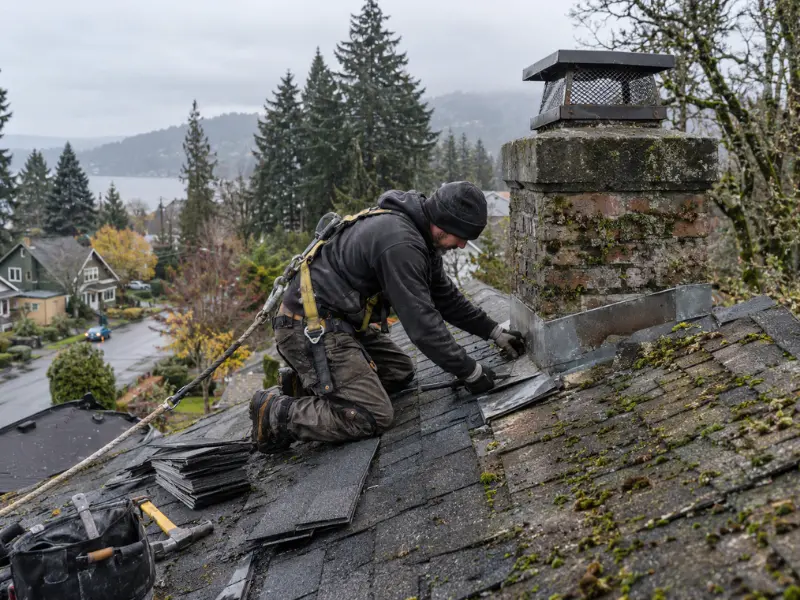
Inspect and document thoroughly, photographing everything before anything is disturbed
Provide a detailed written scope of the repair in line-item form, which your adjuster can assess
Be present at the adjuster's inspection if you want them there, to point out damage
Say plainly whether what they see is storm damage or wear, because those are treated very differently
And the one that should end a conversation: in Washington it is unlawful for a service provider to make a regular practice of waiving or paying a claimant's property insurance deductible. An offer to cover your deductible is not a discount — our Pierce contractor guide covers the full storm-chaser filter, and the Thurston replacement guide covers how policies treat sudden damage against wear.
How Do You Verify an L&I Licence?
How do I verify a Washington roofing contractor's L&I license: use the state's free Verify a Contractor tool, and check five things rather than one.
Registration active today rather than merely on file. The workers' compensation account open — the one that protects you directly. Bond and liability insurance current. The exact business name matching your bid and any permit. And how long they've been registered, since a new entity behind an owner whose previous companies closed is worth a question.
Washington registers contractors rather than licensing them by examination, so there's no competency exam behind the phrase "licensed and bonded" — it's a floor, not a recommendation. Our Pierce contractor guide sets out the current bond amounts and the full vetting checklist.
What Areas Around Graham Do You Serve?
Graham, Spanaway, Puyallup, Eatonville, Frederickson and Tacoma, plus the wider county — we're based in Spanaway, so a roofing contractor near Spanaway and Puyallup WA is a short run rather than a regional dispatch.
Worth knowing why that matters beyond travel time. Graham is unincorporated, so Pierce County's permit rules apply rather than a city's, and the County's covering-weight limit for the re-roofing exemption is three times more generous than Tacoma's. Graham also sits higher, which raises snow load and makes ice dams a real rather than theoretical risk. Our Graham roofing guide covers both, along with the four services we provide.
Beyond Pierce we cover King and Thurston — see the locations page and finished work in the gallery.
What Do Estimates Cost, and What Should You Ask?
Nothing — estimates and inspections are free, with nothing owed afterwards. Anyone asking which local roofing contractor near me offers free estimates should also ask whether the inspection is free, since they're different offers: an estimate prices work you've already identified, while an inspection finds out whether you need any.
How much do local roofing contractors charge follows roof area and pitch, complexity, material, access, and sheathing replacement once the covering is off — that last one moves quotes most, so get a per-sheet price up front. Our Pierce replacement guide breaks the drivers down.
How do I choose a local roofing contractor, in four questions: what's your workmanship warranty term and is it transferable, what's your L&I number, what's the per-sheet sheathing price, and will you tell me if my roof still has years left? A local roofing company Pierce County WA homeowners keep calling back answers the last one honestly even when it costs them the job.
If you're comparing the best local roofing contractors near Graham WA or looking at top rated local roofers in the Pierce County area, start with the warranty terms in writing.
Frequently Asked Questions
1. What areas around Graham do you serve?
Graham, Spanaway, Puyallup, Eatonville, Frederickson and Tacoma, plus the wider Pierce County area, and we also work across King and Thurston counties. We're based in Spanaway, so Graham is next door rather than a regional dispatch. That proximity matters practically: Graham is unincorporated, so Pierce County's permit rules govern rather than any city's, and the higher elevation toward Rainier raises snow load and makes ice dams a genuine seasonal risk rather than a theoretical one.
2. Are you L&I licensed, bonded, and insured?
Yes, and it's worth knowing what that means in Washington. The state registers contractors rather than licensing them by examination, so there's no competency exam behind the phrase — registration requires a surety bond and liability insurance, which is a floor rather than a recommendation. Verify it yourself through L&I's free Verify a Contractor lookup and check five things: registration active today, workers' compensation account open, bond and insurance current, the exact business name matching your bid, and how long the entity has been registered.
3. Do you offer free roofing estimates?
Yes, and free inspections too — they're different things worth asking about separately. An estimate prices work you've already identified; an inspection establishes whether work is needed at all. An inspection carries a conflict wherever the inspector also sells the remedy, so we handle it by photographing everything and giving you the images whatever you decide, and by saying plainly when a roof has years left rather than manufacturing urgency. Nothing is owed either way.
4. Do you handle storm damage and insurance claims?
We repair storm damage, and there's an important line on the claims side. Under RCW 48.17.410, investigating and negotiating settlement of a claim on a policyholder's behalf is the work of a licensed public adjuster. So a contractor offering to negotiate your settlement is offering to do something the statute reserves to licensed adjusters — and one who negotiates the payout then performs the repair has a conflict. What we do is inspect and document thoroughly, provide a detailed written scope your adjuster can assess, attend their inspection if you want, and tell you plainly whether damage is storm-related or wear.
5. Do you offer manufacturer-backed warranties (GAF, Owens Corning)?
Every project is backed by our workmanship warranty, which covers installation — and that's the cover that matters most, since the large majority of roof problems trace to how a roof went on rather than the product. Separately, major manufacturers run contractor certification programmes that unlock enhanced system warranties covering the full roofing system rather than shingles alone. Those require the manufacturer's complete system, which affects specification and cost. Ask any contractor which programme and tier they hold, and what the full-system requirement means for your quote.
Contact Roosevelt Roofing LLC
Roosevelt Roofing LLC Serving Graham, WA and the South Sound Phone: (253) 318-3543 Hours: Monday–Sunday, 6:00 AM – 9:00 PM Family-owned and veteran-owned, based in Spanaway and serving Graham, Eatonville, Puyallup, Frederickson and Tacoma, plus King and Thurston County.
Storm damage, or just comparing quotes? Request a free estimate or call (253) 318-3543 — we'll document what we find and give you a written scope you can take to your adjuster.
