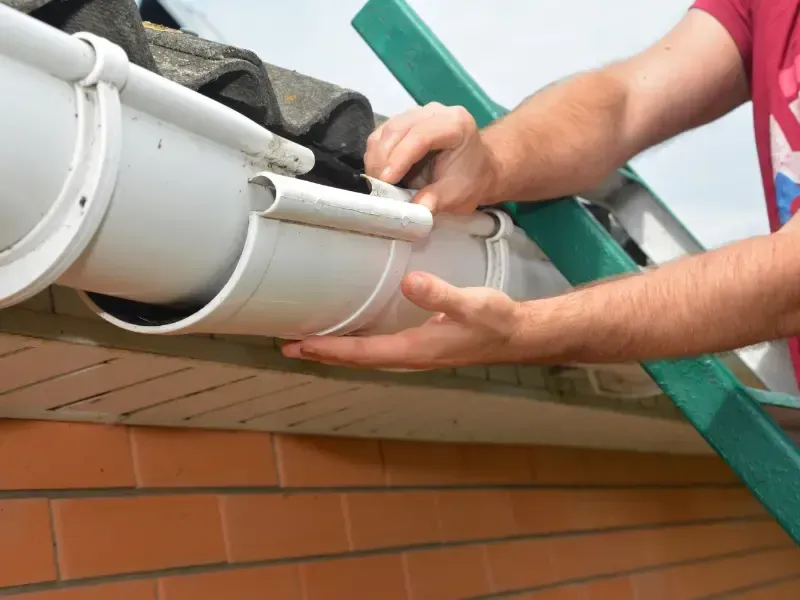
How Often Should Gutters Be Cleaned in Pierce County, WA?
Twice a year is the working answer for most Pierce County homes — spring and autumn, because conifers and deciduous trees drop on different schedules. Roosevelt Roofing LLC handles gutter cleaning in Pierce County, WA, and the damage clogged gutters cause below the roofline usually costs more than the damage above it.
By Eric Haugh, Owner · Last updated August 7, 2026
How Often Should Gutters Be Cleaned Here?
Ask how often should gutters be cleaned and the national advice comes back as once a year. In Pierce County that is usually wrong, and the reason is that we have two debris seasons rather than one.
Autumn is the obvious one: deciduous leaves come down from October into November, and gutters fill fast. Everyone knows to look then.
Late spring and early summer is the one people miss. Conifers shed too — Douglas fir and pine drop needles through the warmer months, and fir also drops catkins and pollen in spring. Needle litter is worse for gutters than leaves in one specific way: leaves tend to sit as a mat that water can eventually channel through, while needles pack densely and go straight into the downspout throat, where they knit into a plug that water will not pass at all.
So the working schedule is twice yearly for most homes, and more often where canopy overhangs the roof directly. Lots with fir or pine within reach of the gutter line often need three visits. Open lots with no overhanging canopy can genuinely manage on one.
Two additional triggers regardless of schedule. After any significant windstorm, because a single event can drop enough small branch and needle debris to block a downspout outright. And before the wet season starts in earnest, because a gutter that is marginal in September is overwhelmed in November.
For the Spanaway area specifically, our gutter cleaning guide for Spanaway covers local service in more detail.
Can Clogged Gutters Damage My Roof?
Yes, and the mechanism is specific enough to be worth understanding, because it explains why the damage compounds rather than staying still.
A blocked gutter fills and overflows. Some of that water goes over the front edge, which is visible and looks like the whole problem. The rest backs up behind the gutter and gets under the drip edge, onto the top of the fascia and the exposed edge of the roof sheathing. That is the part nobody sees.

The feedback loop is the important part. Wet fascia softens, the hidden hangers screwed into it lose purchase, the gutter sags, the sag destroys the slope that made the gutter work, and the standing water that results accelerates everything. A gutter that has begun to pull away from the fascia is not a gutter problem any more — it is a fascia repair with a gutter attached.
So can clogged gutters damage my roof: yes, at the eave, which is where a great many of the leaks we trace actually originate. Our guide to roof repair in Pierce County covers what that repair looks like, and spotting roof damage covers the visible warning signs.
What Happens Below the Roofline
This is the part that costs the most, and it has nothing to do with the roof.
A working gutter system moves roof runoff away from the building. A blocked one dumps it in a concentrated stream at the base of the wall, over and over, through a wet season that runs from October to April. In this region that produces three problems in sequence.
Soil saturation at the foundation. Repeated concentrated discharge keeps the perimeter soil wet through the winter rather than letting it drain and dry.
Crawlspace moisture. Most Pierce County homes sit over crawlspaces, and this is where chronic overflow does real damage. Persistent perimeter saturation raises crawlspace humidity, and a damp crawlspace means condensation on framing, insulation that sags and loses value, and conditions that support wood decay and mould. Homeowners investigate a musty smell for months without connecting it to the gutter above.
Erosion and hardscape movement. Concentrated discharge carves out planting beds, undermines walkway and patio edges, and washes bark and gravel into the lawn.
The fix is not just clearing the gutter — it is making sure the water leaves properly at the bottom, which is the next section.

Clearing Is Not the Same as Flushing
There is a real difference between the two, and it decides whether a cleaning actually accomplished anything.
Clearing means removing the debris from the trough. It is the visible part and it is what most homeowners picture.
Flushing means running water through the system afterwards and confirming it exits at the bottom of every downspout. A gutter can look immaculate from the ground and still be useless if a plug of compacted needles sits in the downspout elbow. Downspout blockages are more common than trough blockages in conifer country, and they are invisible from above.
Proper gutter maintenance Lakewood WA and county-wide should include: clearing the troughs, flushing each run, confirming discharge at every downspout outlet, checking hanger security and slope while up there, and looking at where the water actually goes once it leaves the downspout. That last item is routinely skipped. A downspout discharging two feet from the foundation has moved the problem twelve inches, not solved it — extensions, splash blocks, or a tightline to a proper discharge point are what finish the job.
On the question of which gutter cleaning method is best for PNW debris: hand clearing followed by a flush. Blowers move dry leaves efficiently but struggle with the wet, compacted needle mats that are typical here, and they do nothing for downspouts. Pressure washing gutters is unnecessary and risks driving debris further into the downspout.
Gutter Guards: The Honest Version
We install them, and we will still tell you what they do and do not do.
Guards reduce cleaning frequency. They do not eliminate maintenance, and in conifer country that gap is wider than the marketing suggests. Screens and mesh that comfortably reject maple leaves still admit fir needles, or trap them on the surface where they sit as a mat that sheds water off the front of the gutter instead of into it. Micro-mesh performs better on needles but blinds over with pollen, grit, and moss fines, and once blinded it sheds water the same way.
Three practical points. Guards change the maintenance rather than removing it — surfaces need clearing and, on many systems, panels need lifting to inspect the trough beneath. Guards can make cleaning cost more when panels have to come off and go back. And guards do nothing for downspouts that were already partially plugged when they were installed.
Where guards genuinely earn their cost is on tall or difficult-access homes where each visit is expensive, and on deciduous-dominant lots. Under a stand of Douglas fir, expect to keep maintaining them.
Ice Dams: Gutters Are Not the Cause
This one deserves a straight answer, because it is widely misunderstood and it is often sold dishonestly.
Ice dams are not caused by gutters, and cleaning gutters does not prevent them. According to the Department of Energy's Building America Solution Center, ice dam formation requires three things: snow on the roof, a poorly air-sealed or poorly insulated attic, and freezing temperatures. Heat escaping the house warms the underside of the roof deck, melts snow above it, and that meltwater runs down and refreezes at the cold eave, building a ridge that dams the water behind it. Notably, as little as two inches of snow on a roof is enough.
Gutters appear nowhere in that causal chain. What clean gutters do is give meltwater somewhere to go once it reaches the eave, which reduces secondary damage — and a gutter packed with frozen debris certainly makes things worse. But the cause is attic heat loss, and the fix is air sealing the ceiling plane, adequate insulation, and balanced soffit-to-ridge ventilation.
The Pierce County context matters too. In the lowlands — Tacoma, Puyallup, Lakewood, University Place — sustained snow cover is uncommon enough that ice dams are a rare event rather than an annual one. At elevation toward Graham, Eatonville, and the Mount Rainier foothills, they are a genuine seasonal risk, and given the two-inch threshold they do not require a remarkable winter.
So if someone sells you a gutter cleaning as ice dam prevention, they are selling you a real service under a false label. Buy the cleaning because it protects your fascia, your crawlspace, and your foundation. Fix ice dams in the attic.
Cost, Permits, and Pierce County Areas
On budget, how much does gutter cleaning cost depends on linear footage, the number of storeys, roof pitch and access, whether guards have to be removed and reinstalled, and how compacted the debris is. Single-storey homes with straightforward access sit at the low end; two- and three-storey homes and steep pitches need more staging and more time. Bundling with roof moss treatment on the same visit costs meaningfully less than two separate trips, and the two jobs share the same access setup. We quote from the property and estimates are free.
On permits: no. Cleaning gutters is maintenance, not construction, and Pierce County's guidance on work exempt from building permits does not reach routine maintenance. Replacing a gutter system is also generally maintenance rather than permitted construction, though changing roof structure or drainage into the public system is a different matter. Nobody should be telling you a gutter cleaning needs a permit.
Across the county, canopy decides frequency more than city boundaries do.
Gig Harbor, Browns Point, and the wooded waterfront edges — dense conifer cover and the highest debris load. Three visits a year is common.
Tacoma's older neighbourhoods — mature street trees and complex rooflines with multiple valleys funnelling debris into short gutter runs. Most gutter cleaners Tacoma WA homeowners call are dealing with valley-fed blockages.
Puyallup, Sumner, and Bonney Lake — mixed exposure, and where a gutter cleaning service Puyallup WA residents book in autumn often reveals fascia damage from previous seasons.
Spanaway, Graham, and Eatonville — large lots with fir stands, so needle load rather than leaf load, and the elevation where ice dams become a real consideration.
We serve Pierce County, Thurston County, and King County. The service is on our roof and gutter cleaning page, the full area list is on our locations page, completed work is in our gallery, and where a roof has reached the end of its life rather than just needing maintenance, our Pierce County roof replacement guide and replacement service page cover that.
If you have been searching gutter cleaning Pierce County WA, comparing the best gutter cleaning services near Tacoma WA, or shortlisting the top rated gutter cleaners in Pierce County, ask one question: do you flush the downspouts and confirm discharge, or just clear the troughs? The answer tells you whether you are buying a finished job.

Frequently Asked Questions
1. How often should gutters be cleaned in the Pacific Northwest?
Twice a year for most homes, rather than the once-a-year figure quoted nationally, because this region has two debris seasons. Autumn brings deciduous leaf fall, and late spring through summer brings conifer needle cast plus fir catkins and pollen. Needles are the worse problem because they pack densely and plug downspout throats. Lots with fir or pine overhanging the roof often need three visits; open lots with no overhanging canopy can manage on one. Also clean after any significant windstorm.
2. Can clogged gutters cause roof leaks?
Yes, at the eave. A blocked gutter overflows both forward and backward, and the backward flow gets under the drip edge onto the fascia and the exposed edge of the roof sheathing. Repeated wetting there rots the sheathing edge inward and saturates the fascia, which causes hidden hangers to lose their grip so the gutter sags and loses slope, making the standing water worse. Leaks that appear at the eave are frequently gutter problems rather than roof problems.
3. What is the average cost of gutter cleaning in WA?
Cost is driven by linear footage, number of storeys, roof pitch and access difficulty, whether gutter guards must be removed and reinstalled, and how compacted the debris is. Single-storey homes with easy access sit at the low end, while two- and three-storey homes and steep pitches require more staging and time. Bundling gutter cleaning with roof moss treatment on the same visit costs considerably less than booking two separate trips, since both share the same access setup.
4. Do I need a permit to clean gutters in Pierce County?
No. Gutter cleaning is routine maintenance rather than construction, and permit requirements do not reach it. Replacing an existing gutter system is also generally treated as maintenance rather than permitted construction. Permits become relevant when work changes roof structure, alters the roofline, or connects drainage into the public stormwater system. Anyone telling you a gutter cleaning requires a permit is mistaken.
5. Can gutter cleaning prevent ice dams in the PNW?
No. Ice dams require snow on the roof, a poorly air-sealed or insulated attic, and freezing temperatures — gutters are not part of the cause. Heat escaping into the attic melts snow above, and the meltwater refreezes at the cold eave to form the dam, with as little as two inches of snow enough to start it. Clean gutters help meltwater drain and reduce secondary damage, but the actual fix is attic air sealing, insulation, and balanced ventilation. Ice dams are uncommon in the Pierce County lowlands and a genuine risk at elevation.
Contact Roosevelt Roofing LLC
Roosevelt Roofing LLC Serving Tacoma, Pierce County, and the South Puget Sound Phone: (253) 318-3543 Hours: Monday–Sunday, 6:00 AM – 9:00 PM Family-owned and veteran-owned, serving Pierce County including Tacoma, Puyallup, Lakewood, Spanaway, Graham, Eatonville, Gig Harbor, and Bonney Lake, plus Thurston and King County.
Gutters overflowing, or pulling away from the fascia? Request a free estimate or call (253) 318-3543, and we will clear the troughs, flush every downspout, and tell you where the water is actually going.
