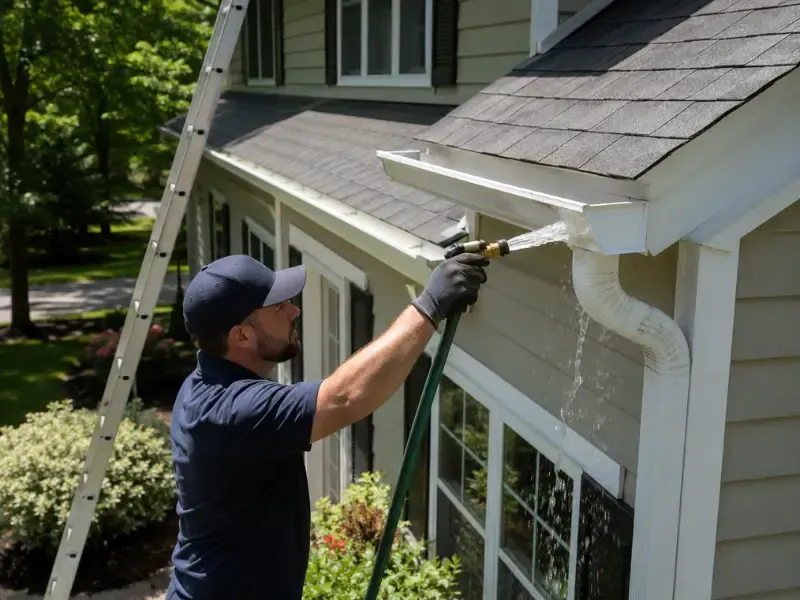
What Do Gutter Cleaning Services in Pierce County, WA Cover?
Gutter Cleaning Services in Pierce County, WA mean two visits a year for most homes, because conifers and deciduous trees drop on different schedules. And the damage clogged gutters cause below the roofline usually costs more than anything above it.
By Eric Haugh, Owner · Last updated September 4, 2026
How Often Should Gutters Be Cleaned Here?
How often should gutters be cleaned in Washington? National advice says once a year. In Pierce County that's usually wrong, because we get two debris seasons.
Autumn is the obvious one — deciduous leaves from October into November.
Late spring and summer is the one people miss. Fir and pine shed needles through the warmer months, plus catkins and pollen. Needles are worse than leaves in one specific way: leaves mat and water eventually channels through, while needles pack densely and travel straight into the downspout throat, knitting into a plug water won't pass at all.
So twice yearly for most homes, three times where fir or pine overhangs the gutter line, and once on an open lot. Two triggers regardless: after any windstorm, since one event can block a downspout, and before the wet season starts, because a gutter that's marginal in September is overwhelmed in November.
For Spanaway specifically, our Spanaway gutter guide covers local service.
How Do Clogged Gutters Damage a Roof?
Can clogged gutters damage my roof? Yes, and the mechanism explains why it compounds rather than sitting still.
A blocked gutter fills and overflows. Some water goes over the front edge, which is visible and looks like the whole problem. The rest backs up behind the gutter, under the drip edge, onto the fascia and the exposed edge of the roof sheathing. That's the part nobody sees.
Where | What fails | Why it compounds |
Behind the gutter | Fascia saturates and softens | Hidden hangers lose grip |
At the hangers | Gutter pulls away and tilts | Slope lost, more standing water |
Roof edge | Sheathing edge and underlayment wet repeatedly | Rot spreads inward from the eave |
Soffit | Water tracks in, staining and delamination | Blocks vents, hurts attic airflow |
At grade | Concentrated discharge at the foundation | Saturated soil, crawlspace moisture |
The feedback loop is the point. Wet fascia softens, the hangers screwed into it lose purchase, the gutter sags, the sag destroys the slope that made it work, and standing water accelerates all of it. A gutter pulling away from the fascia isn't a gutter problem any more — it's a fascia repair with a gutter attached, and the eave is where a great many of the leaks we trace actually start. Our roof repair page covers that work.
What Happens Below the Roofline?
This is the expensive part, and it has nothing to do with the roof. A working system moves runoff away from the building. A blocked one dumps it in a concentrated stream at the base of the wall, repeatedly, across a wet season running October to April. Three things follow in sequence.
Soil saturation at the foundation, since repeated discharge keeps perimeter soil wet all winter.
Crawlspace moisture. Most Pierce County homes sit over crawlspaces, and this is where chronic overflow does real damage — raised humidity means condensation on framing, sagging insulation, and conditions supporting decay. People chase a musty smell for months without connecting it to the gutter above.
Erosion, carving out beds and undermining walkway edges.
Why is gutter cleaning important in the Pacific Northwest? Because of that list, not because of the leaves.
Why Is Clearing Not the Same as Flushing?
There is a real difference between the two, and it decides whether a cleaning actually accomplished anything.
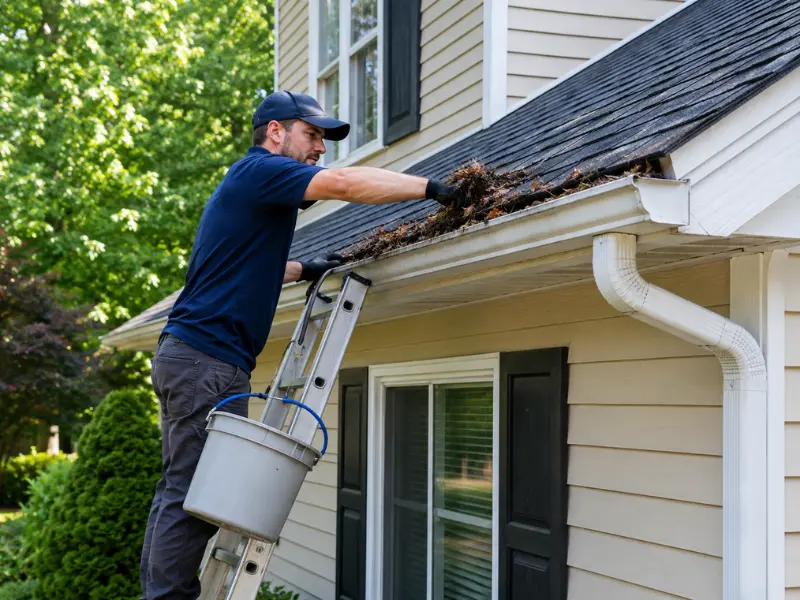
Clearing means removing the debris from the trough. It is the visible part and it is what most homeowners picture.
Flushing means running water through the system afterwards and confirming it exits at the bottom of every downspout. A gutter can look immaculate from the ground and still be useless if a plug of compacted needles sits in the downspout elbow. Downspout blockages are more common than trough blockages in conifer country, and they are invisible from above.
A finished job means clearing the troughs, flushing each run, confirming discharge at every outlet, checking hanger security and slope while up there, and looking at where the water goes once it leaves the downspout. That last item gets skipped routinely — a downspout discharging two feet from the foundation has moved the problem twelve inches, not solved it.
On the question of which gutter cleaning method is best for PNW debris: hand clearing followed by a flush. Blowers move dry leaves efficiently but struggle with the wet, compacted needle mats that are typical here, and they do nothing for downspouts. Pressure washing gutters is unnecessary and risks driving debris further into the downspout.
What Do Gutter Guards Actually Do?
We install them, and we'll still tell you what they don't do.
Guards reduce cleaning frequency. They don't remove maintenance, and in conifer country that gap is wider than the marketing suggests. Screens that comfortably reject maple leaves still admit fir needles, or trap them on the surface as a mat that sheds water off the front instead of into the trough. Micro-mesh handles needles better but blinds over with pollen, grit and moss fines, then sheds water the same way.
Three points. Guards change maintenance rather than ending it, can make each visit cost more since panels come off and go back, and do nothing for a downspout already partly plugged when fitted. They earn their money on tall or awkward-access homes and deciduous lots. Under Douglas fir, budget to keep maintaining them.
Why Are Gutters Not the Cause of Ice Dams?
Straight answer, because this gets sold dishonestly. Ice dams aren't caused by gutters, and cleaning them doesn't prevent them. The Department of Energy's Building America Solution Center sets out that ice dam formation requires three things: snow on the roof, a poorly air-sealed or poorly insulated attic, and freezing temperatures. Heat escaping the house warms the underside of the deck, melts snow above it, and the meltwater refreezes at the cold eave. As little as two inches of snow is enough.
Gutters appear nowhere in that chain. Clean gutters give meltwater somewhere to go once it reaches the eave, which limits secondary damage — and a gutter packed with frozen debris certainly makes things worse. But the cause is attic heat loss, and the fix is air sealing the ceiling plane, adequate insulation, and balanced soffit-to-ridge ventilation.
Locally it matters where you are: sustained snow is uncommon in Tacoma, Puyallup and Lakewood, while at elevation toward Graham and Eatonville it's a genuine seasonal risk. Anyone selling gutter cleaning as ice dam prevention is selling a real service under a false label. Buy it for your fascia, your crawlspace and your foundation. Fix ice dams in the attic.
How Much Does Gutter Cleaning Cost in Pierce County?
How much does gutter cleaning cost in Pierce County follows linear footage, number of storeys, roof pitch and access, whether guards need removing and refitting, and how compacted the debris is. Single-storey with clear access sits at the low end; three storeys and steep pitch need staging. Bundling gutter debris removal with roof moss treatment on one visit costs meaningfully less than two trips, since both share the same access setup. We quote from the property and estimates are free.
On permits: no. Cleaning is maintenance rather than construction, and nobody should be telling you otherwise.
Canopy decides frequency more than city boundaries.
Gig Harbor, Browns Point and the wooded waterfront — dense conifer cover, highest debris load, three visits common.
Tacoma's older neighbourhoods — mature street trees and complex rooflines funnelling debris into short runs, so most gutter cleaners Tacoma WA homeowners call are dealing with valley-fed blockages.
Puyallup, Sumner and Bonney Lake — mixed exposure, and where a gutter cleaning service Puyallup WA residents book in autumn often reveals fascia damage from earlier seasons.
Spanaway, Graham and Eatonville — fir stands, so needle load rather than leaf, and the elevation where ice dams become real. A proper gutter maintenance service means the same method everywhere — clear, flush, confirm discharge — whether that's gutter maintenance Lakewood WA or up at elevation.
We serve Pierce County, Thurston County and King County. The service sits on our roof and gutter cleaning page, the area list on our locations page, and finished work in the gallery.
Searching gutter cleaning services near me Tacoma WA, or gutter cleaning Pierce County WA? Ask one question: do you flush the downspouts and confirm discharge, or just clear the troughs? Any firm offering gutter cleaning services Pierce County Washington homeowners can rely on answers the first way — and the best gutter contractor Puyallup WA residents recommend volunteers it.
Frequently Asked Questions
1. How much does gutter cleaning cost in Pierce County, WA?
Linear footage, how many storeys, roof pitch and access, whether guards come off and go back, and how compacted the debris is. Single-storey with clear ground sits at the bottom of the range; three storeys with steep pitch sits at the top. The saving worth asking about is scheduling — gutter work and roof moss treatment share the same staging, so one visit costs less than two.
2. How often should gutters be cleaned in the rainy PNW?
Twice a year for most Pierce County homes, because there are two debris seasons — deciduous leaves from October into November, and conifer needles, catkins and pollen through late spring and summer. Three visits where fir or pine overhangs the gutter line; once on an open lot with no canopy. Two triggers regardless: after any windstorm, and before the wet season begins.
3. What happens if I don't clean my gutters?
Overflow goes two directions and the invisible one costs more. Water spilling over the front is obvious. Water backing up behind the gutter reaches the fascia and the exposed edge of the roof sheathing, and once the fascia softens the hidden hangers lose grip, the gutter sags, and the slope that made it work is gone. Below the roofline, concentrated discharge saturates foundation soil through a wet season and raises crawlspace humidity, which is where the genuinely expensive damage happens.
4. Do you install gutter guards too?
Yes, with a caveat. Guards reduce cleaning frequency rather than removing the need, and in conifer country that gap is wide — screens that reject maple leaves still admit fir needles, and micro-mesh blinds over with pollen and grit, then sheds water off the front rather than into the trough. They also raise the cost per visit, since panels come off and go back, and do nothing for an already-blocked downspout. They pay off on tall homes and deciduous lots.
5. Do you clear downspouts as well?
Yes, and it decides whether a cleaning accomplished anything. Clearing empties the trough; a gutter cleaning and flush runs water through afterwards and confirms it exits at every downspout. In conifer country downspout plugs are more common than trough blockages and invisible from above, since needles pack into the throat rather than matting. We also check where the water goes once it leaves the downspout.
Contact Roosevelt Roofing LLC
Roosevelt Roofing LLC Serving Tacoma, Pierce County, and the South Puget Sound Phone: (253) 318-3543 Hours: Monday–Sunday, 6:00 AM – 9:00 PM Family-owned and veteran-owned, serving Pierce County including Tacoma, Puyallup, Lakewood, Spanaway, Graham, Eatonville, Gig Harbor, and Bonney Lake, plus Thurston and King County.
Gutters overflowing, or pulling away from the fascia? Request a free estimate or call (253) 318-3543, and we will clear the troughs, flush every downspout, and tell you where the water is actually going.
