

BLOGS
When Is Roof Replacement Due on a Pierce County Home?
Roof replacement is due on a Pierce County home when whole slopes are worn, the attic stays damp, and repairs keep coming back. Age alone doesn't decide it. That's why Roosevelt Roofing LLC reads each slope and the attic first. Then you replace the roof only when it's truly worn out.
By Eric Haugh, Owner · Last updated November 9, 2026
How do you read your roof slope by slope before calling for roof replacement?
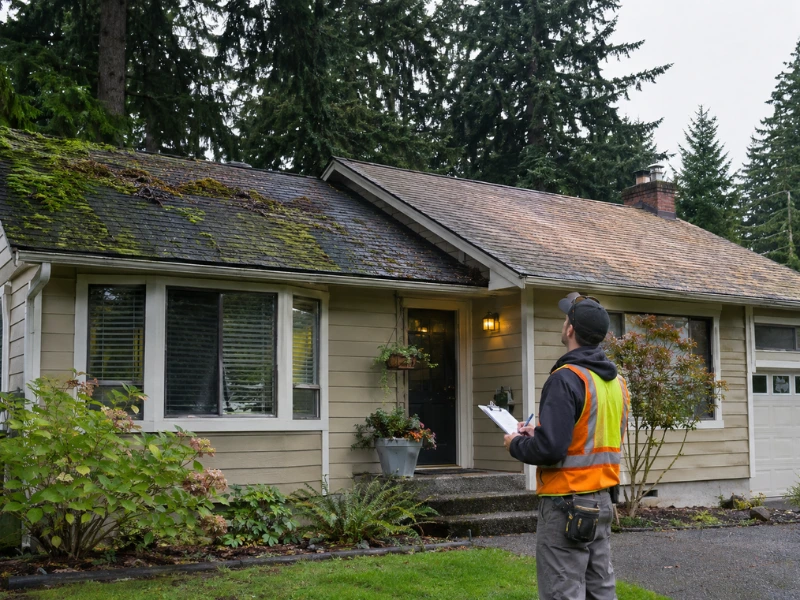
You read it one slope at a time, because roofs here rarely wear evenly. A south-facing slope in Graham can look fine while the north slope under the firs is falling apart. So "how old is it?" matters less than which side is failing, and how fast.
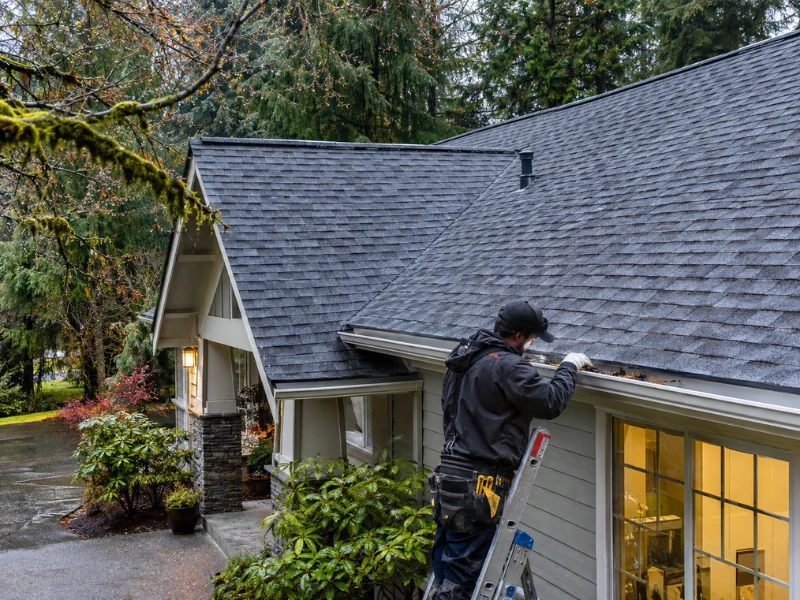
Here's what to look at from the ground with binoculars, or from a ladder at the gutter:
Where to look | What you might see | What it usually means |
North slope under trees | Thick moss, shingle edges lifting | That slope is ahead of the rest of the roof |
South and west slopes | Bare spots, curling, brittle tabs | Sun wear; often the true age of the roof |
Valleys | Debris piles, dark streaks | Water slows here and finds every weak seam |
Gutters and downspouts | Heavy granule grit | Shingles are shedding their protective layer |
Pipes, vents and chimney | Cracked boots, loose flashing | Often a repair, not a replacement |
Eaves and fascia | Soft or stained wood | Water may already be reaching the deck |
One rule of thumb helps. If the problems sit in one or two spots, a repair usually makes sense. But if every slope shows wear, you're paying to patch a roof that's leaving anyway.
What does your attic tell you before a roofer climbs up?
Your attic tells you whether water is already getting past the shingles. In fact, it's often the most honest part of the inspection. Nothing up there gets painted or cleaned for a sale.
Take a flashlight up on a dry afternoon and check for:
Daylight around vent pipes or along the ridge
Dark, stained sheathing, especially near the eaves on the north side
Rusty nail tips poking through the roof deck, a sign of condensation
Damp or flattened insulation below a valley
Bathroom fans that blow into the attic instead of outside
That last one surprises a lot of homeowners. A bath fan dumping warm, wet air into the attic soaks the underside of the roof every winter. As a result, the sheathing can rot from below while the shingles still look fine. So if you see it, mention it when you book. It changes how the new roof gets vented. A few photos from your phone help too, since they let us plan before the first visit.
What should a roof replacement quote say about the decking?
The quote should say how damaged decking will be found, priced and proven. Nobody can see the roof deck until the old shingles come off. However, a good quote still spells out what happens when the crew finds bad wood.
Look for these four things in writing:
A per-sheet price for replacing rotted plywood or OSB
How many sheets are included, if any, in the base price
A promise to call you before going past that number
Photos of every replaced section, taken before it's covered
Also, ask about layers. Many older homes around Tacoma and Lakewood already have two roofs stacked on top of each other. Washington's State Building Code builds on the national residential code. That code doesn't allow a new layer over two existing ones. In other words, a full tear-off is required, and that should be priced into the quote from day one.
A quote that never mentions decking isn't cheaper. It just moves the surprise to the middle of your job.
What makes a new roof last longer in this climate?
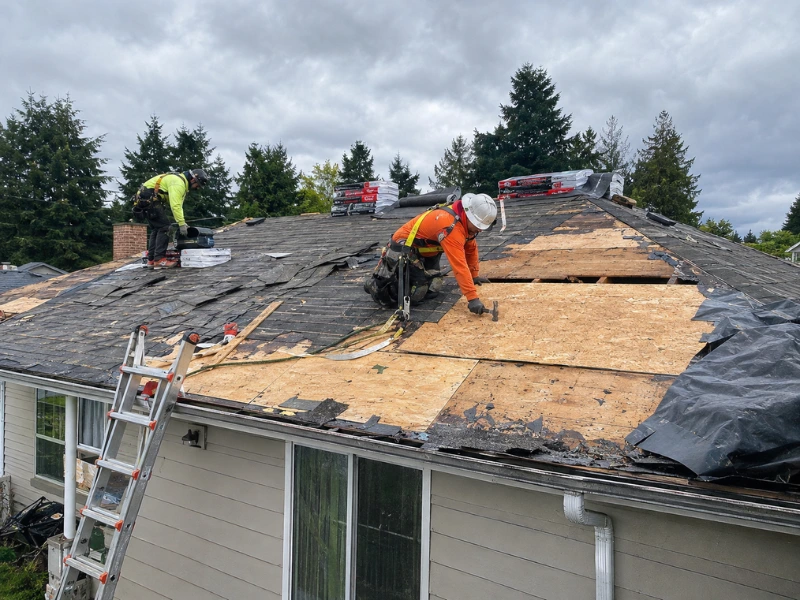
The details under the shingles make it last longer, not just the shingle brand. Our roofs stay wet for long stretches from fall through spring. Because of that, the parts that handle trapped moisture matter as much as what you see from the street.
On a replacement, we pay closest attention to:
Ice and water membrane in the valleys and along the eaves, where water backs up first
Balanced ventilation, with intake at the soffits matched to exhaust at the ridge
New drip edge so water clears the fascia instead of soaking it
New pipe boots and step flashing, since old flashing rarely survives a tear-off
Algae-resistant shingles on homes with heavy tree cover
Ventilation is the one most often skipped. A roof that can't breathe holds moisture under the deck every winter. That wears the wood out from below, no matter how good the shingles are. For materials, see our guide on how roof replacement companies re-roof in Tacoma.
How should you handle moss before and after the new roof goes on?
You should remove it gently, then change the conditions that let it grow back. Moss loves shade, needles and trapped water. So killing it once without fixing those conditions only buys a year or two.
Here's what works on the roofs we see:
Trim branches that hang over the roof, so slopes dry faster after rain.
Keep gutters clear of fir needles, which hold water against the eaves. Our roof and gutter cleaning service handles both.
Brush, don't blast. Pressure washing strips granules and can drive water up under the shingles.
Be careful with zinc products. The Washington State Department of Ecology found moss control was the largest zinc source in its study area, and zinc is toxic to fish.
That last point matters around here. Roof runoff from much of the county ends up in local creeks. So a gentler treatment, done more often, is the better habit.
Where do we replace roofs across Pierce County?
We replace roofs across Pierce County, working out of Spanaway. That covers Graham, Frederickson and Eatonville, where tall firs and long wet seasons are hard on north slopes. It also covers older neighborhoods closer to the Sound, where layered roofs and aging decks are common.
If you're looking for roof replacement near Tacoma and Puyallup WA, we cover both regularly:
Tacoma roof replacement, from the North End to South Tacoma
Puyallup roof replacement, including South Hill
Lakewood roof replacement, just west of Spanaway
We also work in Thurston County and King County. For the full picture of our work here, see our Pierce County roofing page. And before you commit to a roof replacement, ask for a slope-by-slope inspection. It's the fastest way to know whether you need a new roof or just a good repair.
Frequently asked questions
1. How long should a roof last here, against the number on the warranty?
You should expect any good architectural shingle roof to last around 20-25 years. Even if your roof has a 30-year or lifetime warranty. A roof will not last as long in areas of high moisture. If you are wondering how long will my roof last? Your roof will depend on how much shade and air flow it gets. Most of the time in Western Washington your roof will depend on if it is on the North side. Older three tab roofs will usually fail after 15-20 years.
2. How much life does moss take off a roof?
Thick growths of moss can cause several years lost from a roof. Moss causes damage to shingles by trapping moisture on them and forcing the edges up. This causes water to get to the nails and decking. If you are wondering does moss reduce the life of a roof? Yes it does mainly on shaded areas.
3. What gets found under the old layers once they come off?
We usually find soft or blistered decking near the eaves, valleys and chimneys. Tear-off and decking can also show us if there is skip decking from an old cedar shake roof. This will require new decking before shingles can be fitted. Often people are surprised to find there is no underlay, rusty flashing and hidden shake roofs underneath.
4. How many dry days does a replacement need, and when is the season?
Typically 1-3 dry days are needed for an average sized home. Larger or steep roofs will require more. Our peak season is late Spring to early Autumn. This is when the weather is most predictable. We can do work during the winter but between storms. Shingles need to be warm to fully seal so extra hand sealing may be required.
5. What does a replacement cost across the county?
On average in Washington, a simple shingle roof will cost around $8,000. Up to over $40,000 for a large tear off. The size, pitch, number of layers and decking will affect the price more than the town. The only way to truly know what it will cost you is to have a measured site survey. We offer these for free.
Visit or Call Us
Roosevelt Roofing LLC
Address: Spanaway, WA (service-area business)
Phone: (253) 318-3543
Email: [email protected]
Family-owned, veteran-owned roofing contractor
Serving Graham, Spanaway, Puyallup, Eatonville, Frederickson, Tacoma, and King and Thurston counties. Call for a free estimate, or use our contact page to book an inspection.

QUICK LINKS
SERVICE AREAS
CONTACT INFORMATION
Eric Roosevelt @ Roosevelt Roofing LLC
CALL US
HOURS
Mon - Sun 6:00 am - 9:00 pm
Copyright 2026. Roosevelt Roofing LLc. All Rights Reserved.